You’re Paying More for Power. Blame Me.
You’re Paying More for Power. Blame Me.
You’re Paying More for Power. Blame Me.
Mar 15, 2026
Mar 15, 2026
Mar 15, 2026
In 2005, I was sitting at a conference table in Oakland, California with a group of government officials. I was the executive director of a nonprofit that had supported Assembly Bill 32—the landmark California climate law that required greenhouse gas reductions. Our group’s goal was to devise policies, regulations, and market incentives to push green building and expand solar and wind power.
At the time it felt like progress. But looking back, those decisions were the first steps in a series of mandates, cost shifts, and constraints on reliable power that drove up Americans’ utility bills.
When power is painful
Today energy bills are rising. When energy gets unaffordable, everything built on it gets unaffordable too: food, housing, transportation, consumer goods. People are hurting, businesses are breaking, and families feel squeezed.
When people are in pain, they look for someone to blame. Lately, they’ve settled on two villains: data centers and utilities. Data centers, they say, are sucking up all the electricity and driving power prices higher. And utilities are jacking up rates because they’re greedy. Both explanations feel true to people in pain. But the data show that both explanations are false.
Look at Virginia, home to the largest cluster of data centers on Earth. Despite explosive growth in electricity demand, residents have seen below-average price increases and pay below-average rates. This runs counter to the prevailing narrative. The same pattern shows up nationwide. From 2019 to 2024, most states with the fastest-growing electricity demand saw prices stay flat or even fall.
Why have electricity prices stayed down where demand has gone up? For years, utilities weren’t delivering power at their full capacity. They could meet growing demand with their existing power plants and wires. So they didn’t have to raise rates. But as of 2025, the slack in the system is gone. Utilities are stretched to capacity. Some have reached the limits of their generating capacity; others are squeezed by transmission bottlenecks. Either way, from here on out, rising demand will push utility bills higher unless we add more reliable supply.
Data centers and utilities aren’t the villains. They’re playing by the same rules of supply and demand as the rest of us. To find a villain, you have to look back at who dealt them the hand they’re playing.
The politics of energy
Over the last 15 years the U.S. has been closing the power plants that kept the grid stable—coal and nuclear. In their place, state governments have forced utilities to build wind and solar plants. These plants are often far from where people live, so utilities have to build long, expensive transmission lines to deliver the power. Plus solar and wind can’t anchor a stable grid. Their output fluctuates with the weather. For every megawatt of wind or solar that utilities add to the grid, they need almost a full megawatt of stable backup power to keep the lights on.
The result is a grid with two overlapping systems: one weather-dependent; the other, on-demand and reliable. When solar and wind slump, the grid has to rely on costly backup sources. Maintaining two systems to do the job of one is a primary reason electricity is so expensive.
PJM, the nation’s largest grid operator, provides a good example of this two-system grid. In its recent capacity auction, where power plants bid to provide stable power, solar accounted for only 1 percent of dependable capacity, and wind for just 2 percent. The rest comes from other sources. Running two systems at once is expensive. It’s like needing two homes: one has power only sometimes, so you need a second home to rely on when you need light, heat, or A/C. The problem with owning two homes is that you end up paying for both: two mortgages, two tax bills, and two utility bills.
The same is true of the grid.
Electricity costs are 29 percent higher in states that have solar and wind energy mandates. In California, the national leader in mandates, families and businesses pay 109 percent more than the U.S. average.
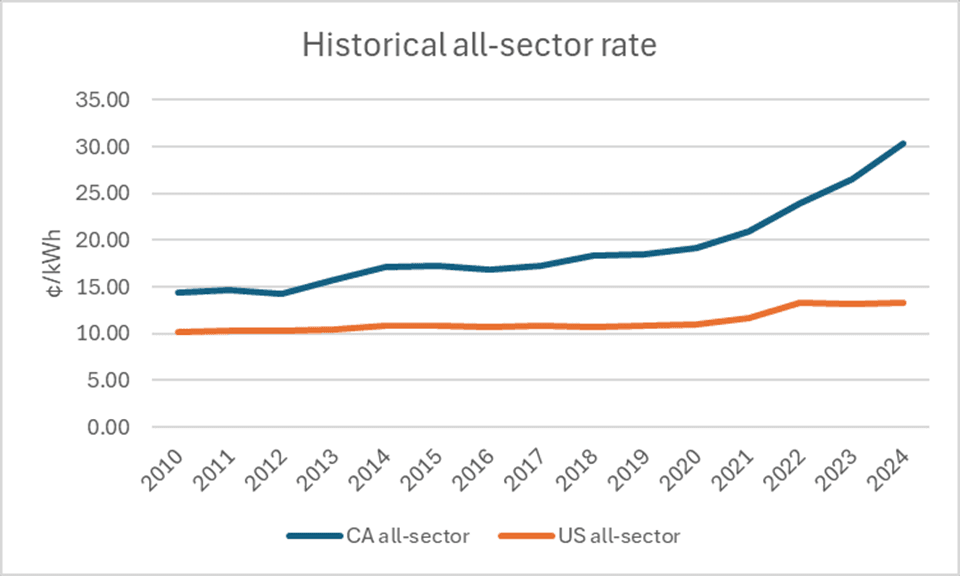
California’s high electricity rates are no mystery. They’re the predictable results of policies that pushed solar and wind while restricting more reliable energy sources. Choking off reliable supply, increasing demand, adding weather-dependent sources that need expensive backups—combine these factors with crushing post-COVID inflation, and prices had nowhere to go but up. That’s the real reason Americans are paying more for power. Not power hungry data centers. Not greedy utilities. Just basic economics hitting the grid from all sides.
Choosing expensive electricity
Expensive electricity is a choice. I know because in 2005 I was in the room when those choices were made. Over the past twenty years, I’ve watched California pour billions into solar subsidies and ratchet up its renewable electricity requirements.
2002: SB 1078 created California’s Renewable Portfolio Standard.
2006: AB 32 imposed statewide greenhouse gas emission limits, permanently linking climate policy to electricity planning.
2007: California launched its Solar Initiative, a multibillion-dollar, ratepayer-funded program, which shifted costs onto customers without solar.
2015: SB 350 raised the renewable electricity procurement mandate to 50 percent by 2030.
2018: SB 100 raised the mandate again and requires renewable and zero carbon resources to supply 100 percent of retail electricity sales by 2045.
Twenty-eight states and Washington D.C. have followed California’s lead and passed wind and solar mandates of their own. Predictably, since 2020, those states have seen electricity prices rise nearly twice as fast as states without them, and utilities in those states have sought rate increases 32 percent more often.
California politicians chose this path, and households are now living with the consequences. Families already face some of the steepest electricity rate increases in the country, and the pain is projected to intensify, with rates expected to reach three times the national average by 2028.
Even worse, American families haven’t yet felt the full impact of these policy choices. The U.S. grid is old and expensive to maintain. About one-third of it needs to be updated, and the cost of those updates will land on monthly bills. Today’s rising costs are just the early tremors of an energy cost explosion. If you think it hurts now, give it a few years. Without action, people will suffer even more.
The solution: bringing affordability back
The good news is that we can fix the problem. We just need to stop pretending that weather-dependent energy systems can run an energy-hungry economy. Here’s what we need to do instead:
Upgrade the grid we have instead of pouring money into new long-distance lines for remote wind and solar projects.
Replace aging coal plants with cleaner natural gas and zero-emission nuclear plants.
Build grid connected on site generation adjacent to large data centers where feasible to reduce strain on the grid.
This approach reduces costs, improves reliability, and cuts emissions: natural gas is cleaner than coal, and nuclear produces no emissions at all. Reliable power isn’t the enemy of clean energy; it’s the foundation of it.
Rising electricity prices are a natural outcome of economic forces: when demand rises and reliable supply doesn’t, prices rise too. It’s time to start building more reliable supply and stop paying for two energy systems that do the job of one. It’s time to bring affordability back—to families, to businesses, to people in pain.
In 2005, I was sitting at a conference table in Oakland, California with a group of government officials. I was the executive director of a nonprofit that had supported Assembly Bill 32—the landmark California climate law that required greenhouse gas reductions. Our group’s goal was to devise policies, regulations, and market incentives to push green building and expand solar and wind power.
At the time it felt like progress. But looking back, those decisions were the first steps in a series of mandates, cost shifts, and constraints on reliable power that drove up Americans’ utility bills.
When power is painful
Today energy bills are rising. When energy gets unaffordable, everything built on it gets unaffordable too: food, housing, transportation, consumer goods. People are hurting, businesses are breaking, and families feel squeezed.
When people are in pain, they look for someone to blame. Lately, they’ve settled on two villains: data centers and utilities. Data centers, they say, are sucking up all the electricity and driving power prices higher. And utilities are jacking up rates because they’re greedy. Both explanations feel true to people in pain. But the data show that both explanations are false.
Look at Virginia, home to the largest cluster of data centers on Earth. Despite explosive growth in electricity demand, residents have seen below-average price increases and pay below-average rates. This runs counter to the prevailing narrative. The same pattern shows up nationwide. From 2019 to 2024, most states with the fastest-growing electricity demand saw prices stay flat or even fall.
Why have electricity prices stayed down where demand has gone up? For years, utilities weren’t delivering power at their full capacity. They could meet growing demand with their existing power plants and wires. So they didn’t have to raise rates. But as of 2025, the slack in the system is gone. Utilities are stretched to capacity. Some have reached the limits of their generating capacity; others are squeezed by transmission bottlenecks. Either way, from here on out, rising demand will push utility bills higher unless we add more reliable supply.
Data centers and utilities aren’t the villains. They’re playing by the same rules of supply and demand as the rest of us. To find a villain, you have to look back at who dealt them the hand they’re playing.
The politics of energy
Over the last 15 years the U.S. has been closing the power plants that kept the grid stable—coal and nuclear. In their place, state governments have forced utilities to build wind and solar plants. These plants are often far from where people live, so utilities have to build long, expensive transmission lines to deliver the power. Plus solar and wind can’t anchor a stable grid. Their output fluctuates with the weather. For every megawatt of wind or solar that utilities add to the grid, they need almost a full megawatt of stable backup power to keep the lights on.
The result is a grid with two overlapping systems: one weather-dependent; the other, on-demand and reliable. When solar and wind slump, the grid has to rely on costly backup sources. Maintaining two systems to do the job of one is a primary reason electricity is so expensive.
PJM, the nation’s largest grid operator, provides a good example of this two-system grid. In its recent capacity auction, where power plants bid to provide stable power, solar accounted for only 1 percent of dependable capacity, and wind for just 2 percent. The rest comes from other sources. Running two systems at once is expensive. It’s like needing two homes: one has power only sometimes, so you need a second home to rely on when you need light, heat, or A/C. The problem with owning two homes is that you end up paying for both: two mortgages, two tax bills, and two utility bills.
The same is true of the grid.
Electricity costs are 29 percent higher in states that have solar and wind energy mandates. In California, the national leader in mandates, families and businesses pay 109 percent more than the U.S. average.
California’s high electricity rates are no mystery. They’re the predictable results of policies that pushed solar and wind while restricting more reliable energy sources. Choking off reliable supply, increasing demand, adding weather-dependent sources that need expensive backups—combine these factors with crushing post-COVID inflation, and prices had nowhere to go but up. That’s the real reason Americans are paying more for power. Not power hungry data centers. Not greedy utilities. Just basic economics hitting the grid from all sides.
Choosing expensive electricity
Expensive electricity is a choice. I know because in 2005 I was in the room when those choices were made. Over the past twenty years, I’ve watched California pour billions into solar subsidies and ratchet up its renewable electricity requirements.
2002: SB 1078 created California’s Renewable Portfolio Standard.
2006: AB 32 imposed statewide greenhouse gas emission limits, permanently linking climate policy to electricity planning.
2007: California launched its Solar Initiative, a multibillion-dollar, ratepayer-funded program, which shifted costs onto customers without solar.
2015: SB 350 raised the renewable electricity procurement mandate to 50 percent by 2030.
2018: SB 100 raised the mandate again and requires renewable and zero carbon resources to supply 100 percent of retail electricity sales by 2045.
Twenty-eight states and Washington D.C. have followed California’s lead and passed wind and solar mandates of their own. Predictably, since 2020, those states have seen electricity prices rise nearly twice as fast as states without them, and utilities in those states have sought rate increases 32 percent more often.
California politicians chose this path, and households are now living with the consequences. Families already face some of the steepest electricity rate increases in the country, and the pain is projected to intensify, with rates expected to reach three times the national average by 2028.
Even worse, American families haven’t yet felt the full impact of these policy choices. The U.S. grid is old and expensive to maintain. About one-third of it needs to be updated, and the cost of those updates will land on monthly bills. Today’s rising costs are just the early tremors of an energy cost explosion. If you think it hurts now, give it a few years. Without action, people will suffer even more.
The solution: bringing affordability back
The good news is that we can fix the problem. We just need to stop pretending that weather-dependent energy systems can run an energy-hungry economy. Here’s what we need to do instead:
Upgrade the grid we have instead of pouring money into new long-distance lines for remote wind and solar projects.
Replace aging coal plants with cleaner natural gas and zero-emission nuclear plants.
Build grid connected on site generation adjacent to large data centers where feasible to reduce strain on the grid.
This approach reduces costs, improves reliability, and cuts emissions: natural gas is cleaner than coal, and nuclear produces no emissions at all. Reliable power isn’t the enemy of clean energy; it’s the foundation of it.
Rising electricity prices are a natural outcome of economic forces: when demand rises and reliable supply doesn’t, prices rise too. It’s time to start building more reliable supply and stop paying for two energy systems that do the job of one. It’s time to bring affordability back—to families, to businesses, to people in pain.
In 2005, I was sitting at a conference table in Oakland, California with a group of government officials. I was the executive director of a nonprofit that had supported Assembly Bill 32—the landmark California climate law that required greenhouse gas reductions. Our group’s goal was to devise policies, regulations, and market incentives to push green building and expand solar and wind power.
At the time it felt like progress. But looking back, those decisions were the first steps in a series of mandates, cost shifts, and constraints on reliable power that drove up Americans’ utility bills.
When power is painful
Today energy bills are rising. When energy gets unaffordable, everything built on it gets unaffordable too: food, housing, transportation, consumer goods. People are hurting, businesses are breaking, and families feel squeezed.
When people are in pain, they look for someone to blame. Lately, they’ve settled on two villains: data centers and utilities. Data centers, they say, are sucking up all the electricity and driving power prices higher. And utilities are jacking up rates because they’re greedy. Both explanations feel true to people in pain. But the data show that both explanations are false.
Look at Virginia, home to the largest cluster of data centers on Earth. Despite explosive growth in electricity demand, residents have seen below-average price increases and pay below-average rates. This runs counter to the prevailing narrative. The same pattern shows up nationwide. From 2019 to 2024, most states with the fastest-growing electricity demand saw prices stay flat or even fall.
Why have electricity prices stayed down where demand has gone up? For years, utilities weren’t delivering power at their full capacity. They could meet growing demand with their existing power plants and wires. So they didn’t have to raise rates. But as of 2025, the slack in the system is gone. Utilities are stretched to capacity. Some have reached the limits of their generating capacity; others are squeezed by transmission bottlenecks. Either way, from here on out, rising demand will push utility bills higher unless we add more reliable supply.
Data centers and utilities aren’t the villains. They’re playing by the same rules of supply and demand as the rest of us. To find a villain, you have to look back at who dealt them the hand they’re playing.
The politics of energy
Over the last 15 years the U.S. has been closing the power plants that kept the grid stable—coal and nuclear. In their place, state governments have forced utilities to build wind and solar plants. These plants are often far from where people live, so utilities have to build long, expensive transmission lines to deliver the power. Plus solar and wind can’t anchor a stable grid. Their output fluctuates with the weather. For every megawatt of wind or solar that utilities add to the grid, they need almost a full megawatt of stable backup power to keep the lights on.
The result is a grid with two overlapping systems: one weather-dependent; the other, on-demand and reliable. When solar and wind slump, the grid has to rely on costly backup sources. Maintaining two systems to do the job of one is a primary reason electricity is so expensive.
PJM, the nation’s largest grid operator, provides a good example of this two-system grid. In its recent capacity auction, where power plants bid to provide stable power, solar accounted for only 1 percent of dependable capacity, and wind for just 2 percent. The rest comes from other sources. Running two systems at once is expensive. It’s like needing two homes: one has power only sometimes, so you need a second home to rely on when you need light, heat, or A/C. The problem with owning two homes is that you end up paying for both: two mortgages, two tax bills, and two utility bills.
The same is true of the grid.
Electricity costs are 29 percent higher in states that have solar and wind energy mandates. In California, the national leader in mandates, families and businesses pay 109 percent more than the U.S. average.
California’s high electricity rates are no mystery. They’re the predictable results of policies that pushed solar and wind while restricting more reliable energy sources. Choking off reliable supply, increasing demand, adding weather-dependent sources that need expensive backups—combine these factors with crushing post-COVID inflation, and prices had nowhere to go but up. That’s the real reason Americans are paying more for power. Not power hungry data centers. Not greedy utilities. Just basic economics hitting the grid from all sides.
Choosing expensive electricity
Expensive electricity is a choice. I know because in 2005 I was in the room when those choices were made. Over the past twenty years, I’ve watched California pour billions into solar subsidies and ratchet up its renewable electricity requirements.
2002: SB 1078 created California’s Renewable Portfolio Standard.
2006: AB 32 imposed statewide greenhouse gas emission limits, permanently linking climate policy to electricity planning.
2007: California launched its Solar Initiative, a multibillion-dollar, ratepayer-funded program, which shifted costs onto customers without solar.
2015: SB 350 raised the renewable electricity procurement mandate to 50 percent by 2030.
2018: SB 100 raised the mandate again and requires renewable and zero carbon resources to supply 100 percent of retail electricity sales by 2045.
Twenty-eight states and Washington D.C. have followed California’s lead and passed wind and solar mandates of their own. Predictably, since 2020, those states have seen electricity prices rise nearly twice as fast as states without them, and utilities in those states have sought rate increases 32 percent more often.
California politicians chose this path, and households are now living with the consequences. Families already face some of the steepest electricity rate increases in the country, and the pain is projected to intensify, with rates expected to reach three times the national average by 2028.
Even worse, American families haven’t yet felt the full impact of these policy choices. The U.S. grid is old and expensive to maintain. About one-third of it needs to be updated, and the cost of those updates will land on monthly bills. Today’s rising costs are just the early tremors of an energy cost explosion. If you think it hurts now, give it a few years. Without action, people will suffer even more.
The solution: bringing affordability back
The good news is that we can fix the problem. We just need to stop pretending that weather-dependent energy systems can run an energy-hungry economy. Here’s what we need to do instead:
Upgrade the grid we have instead of pouring money into new long-distance lines for remote wind and solar projects.
Replace aging coal plants with cleaner natural gas and zero-emission nuclear plants.
Build grid connected on site generation adjacent to large data centers where feasible to reduce strain on the grid.
This approach reduces costs, improves reliability, and cuts emissions: natural gas is cleaner than coal, and nuclear produces no emissions at all. Reliable power isn’t the enemy of clean energy; it’s the foundation of it.
Rising electricity prices are a natural outcome of economic forces: when demand rises and reliable supply doesn’t, prices rise too. It’s time to start building more reliable supply and stop paying for two energy systems that do the job of one. It’s time to bring affordability back—to families, to businesses, to people in pain.
Recent Articles

Sign up to
Truth & Power
Monthly insights on how better energy unlocks prosperity
Sign up to
Truth & Power
Monthly insights on how better energy unlocks prosperity
Sign up to
Truth & Power
Monthly insights on how better energy unlocks prosperity

© 2025 Copyright Brian Gitt. All rights reserved.
© 2025 Copyright Brian Gitt. All rights reserved.
© 2025 Copyright Brian Gitt. All rights reserved.